Sunday, July 31, 2011

Science in the R.I. Special Area Management Plan

William Nuttle, Organizer for CERF 2011 Synthesis Sessions
wnuttle@eco-hydrology.com


Last week NOAA Administrator Jane Lubchenco joined a host of political leaders to announce Rhode Island’s Ocean Special Area Management Plan (Ocean SAMP). This is a big deal because NOAA touts Ocean SAMP as the template for implementing coastal and marine spatial planning (CMSP) in the US. CMSP is defined as a comprehensive, adaptive, integrated, ecosystem-based, and transparent spatial planning process, based on sound science. The push to adopt CMSP is international in scope.

In practical terms, CMSP provides a process for analyzing current and anticipated uses of estuaries and coastal waters to determine how to realize commercial, recreational and environmental goals. The motivation behind Ocean SAMP was to get out in front of issues related to installing a couple hundred wind turbines to generate electric power off the Rhode Island coast. The plan encompasses an area of approximately 1,467 square miles, including portions of Block Island Sound, Rhode Island Sound, and the Atlantic Ocean.

If this marks the beginning of the future for coastal planning and management, then widespread implementation of CMSP will affect how coastal and estuarine research is supported and organized in coming years. So, what insights does the Ocean SAMP report provide into what may be the future of our science?

Plan Based on Best Available Information
The Ocean SAMP uses the “best available science” to build a comprehensive understanding of the area’s ecosystems. Through the multi-year process of developing the plan, a Science Advisory Task Force provided expertise and input on issues of science and research. New research was commissioned, and the results of this research are reported in the plan document and in a series of appendices to the main report. A chapter in the main body of the report titled “Ecology of the Ocean SAMP” describes the regional ecosystem.  However, authors opted for using a more traditional, natural history framework;  topics proceed hierarchically from geology and meteorology through physical oceanography, chemical oceanography, and on to biological oceanography.

Coastal and Estuarine Science Moving Forward
Part of the vision for CMSP is the implementation of ecosystem based management of estuarine and coastal areas, thus the attention to thoroughly documenting the ecosystem of the Ocean SAMP at its outset. Ecosystem based management also means committing to conduct ecosystem research, monitoring and analysis on a continual basis as an integral part of management activities in the region. Objectives for the (future?) Ocean SAMP Science Research Agenda are to:
  1. Continue to learn about Rhode Island’s offshore natural resources and human activities; 
  2. Better understand the potential effects of future development and other human impacts; and 
  3. Increase Rhode Island’s understanding of the projected impacts of global climate change. 
Future plans are to convene an advisory group with scientists from partner federal and state agencies, environmental organizations, and users of the Ocean SAMP area. Presumably, it will be up to this group to articulate critical details of the research agenda by identifying data gaps, short- and long-term research priorities, potential partners, and potential funding sources.

The information in this post relates to Topic 6: Management applications of the CERF 2011 synthesis sessions.  I'd like to hear more from anyone who has been directly involved in the development of the Ocean SAMP.

Thursday, July 28, 2011

Case Studies of Coastal Science and Management at Regional Scale

William Nuttle, Organizer for CERF 2011 Synthesis Sessions
wnuttle@eco-hydrology.com

The movement toward coordinated management of coastal and estuarine resources at the regional scale will require greater investment in large-scale ecosystem research capable of providing information needed by managers.  On May 18-19, 2009, NOAA’s Center for Sponsored Coastal Ocean Research convened a workshop to examine existing regional-scale ecosystem research and identify practices that lead to research results with direct management relevance and impact.  This workshop assembled over fifty experts on coastal ecosystem science, management and policy representing all coastal regions of the US, including the Great Lakes, and the republic of Palau.  

Location of 8 regional applied ecosystem research case studies

The eight case studies compiled for discussion at the workshop represent a wide variety of physical and ecological contexts; these include the Great Lakes (8 - Lake Erie), a river-dominated coast (4 - northern Gulf of Mexico), tropical lagoon systems (6 - Micronesia and 3 - South Florida), and coastal ocean systems (5 - California coast, 7 - Bering Sea, 2 - Gulf of Maine, and the 1 - Northwest Atlantic). Case studies were chosen to examine a variety of issues, funding, and participation involved in regional ecosystem research. Each case study provided a unique perspective on planning and implementation of regional ecosystem research from the point-of-view of both scientists and managers.

In all cases, the success of the applied ecosystem research depends on the following essential program support elements:

Overarching goals for management of the regional ecosystem articulated by the cooperating agencies and stakeholders and informed by a shared vision of the ecosystem based in science;

Regional coordination among cooperating management agencies and between managers and research scientists;

Clear project objectives that connect results of research and monitoring to the specific programs and mandates of the cooperating management agencies;

An open process for sharing information between agencies and communicating results of research to managers and stakeholders; and

Regular reporting of progress made toward the over arching ecosystem goals based on quantitative indicators based on ecosystem research and monitoring.

The information in this post relates to Topic 3: Management applications of the CERF 2011 synthesis sessions.  Go here for more information about these case studies from the IAN Program of the University of Maryland.

Wednesday, July 27, 2011

Topics Set for Synthesis Sessions at CERF 2011

William Nuttle, Organizer for CERF 2011 Synthesis Sessions
wnuttle@eco-hydrology.com

Q: How far can you wander into a jungle?
A: Half way.

This riddle came to mind during the June meeting of the Program Committee.  For three days, in Daytona Beach, the committee labored to find our way through the thicket of topics submitted for presentation at the CERF 2011conference in November.  On more than one occasion I found myself wandering off course, distracted reading an abstract that seemed ripe for immediate consumption.  Such were the hazards of this work, but the committee valiantly soldiered on. By the end of day two we finally penetrated to the heart of the jungle and started on the journey back out.  

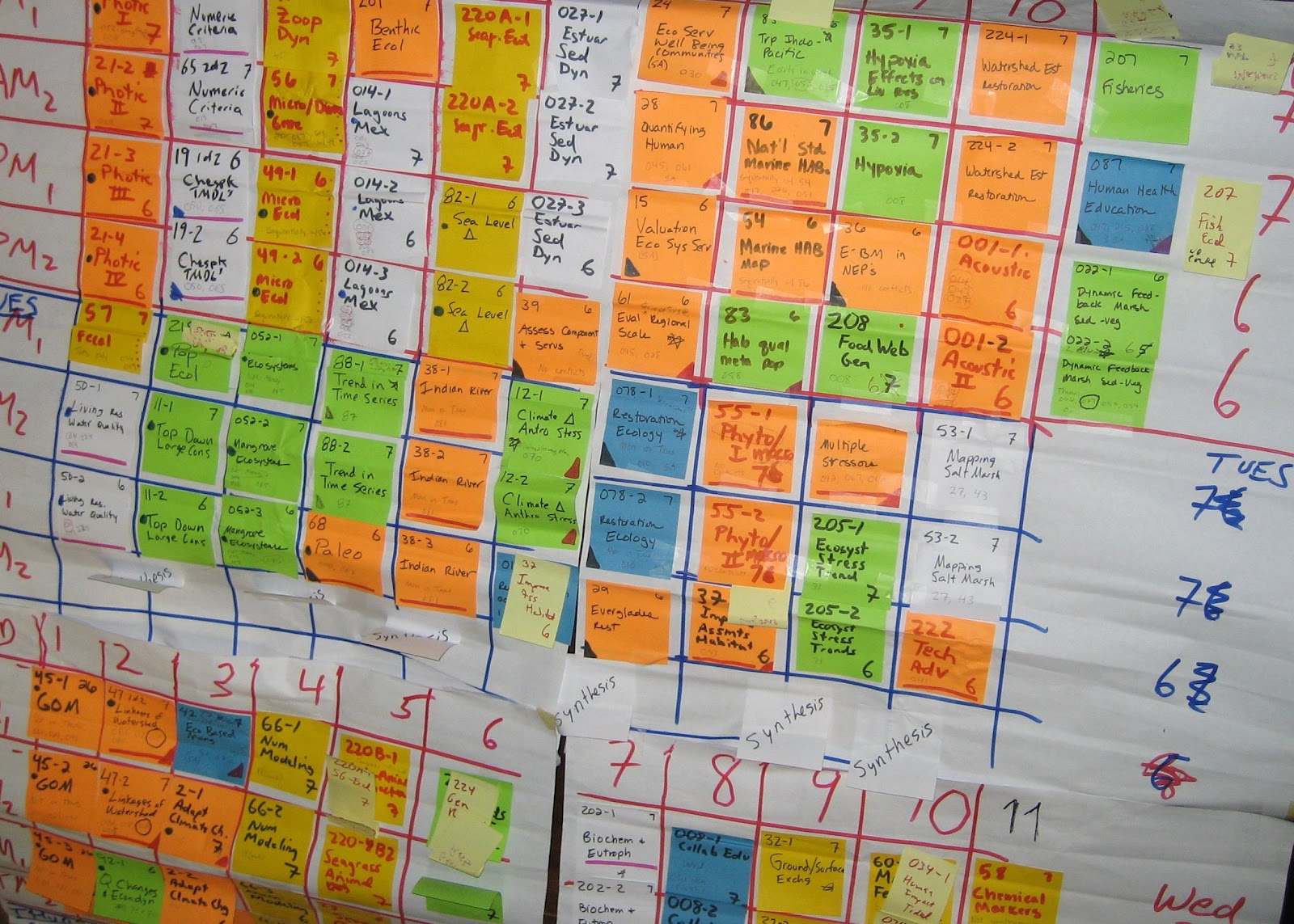
Initial draft of CERF 2011 program - at the heart of the jungle

We have made good progress since then.  The conference program is now final.  Presenters soon will learn their assigned time and location; possibly these emails have already gone out.  And, we have set some markers - the topics for discussion during the synthesis sessions - intended to aid those who will follow us into this jungle during the CERF 2011 meeting in November.

Synthesis at CERF 2011
The synthesis sessions planned for CERF 2011 will examine how integrated ecosystem assessment (IEA) can be used to help societies, estuaries and coasts adapt to change.  Integrated ecosystem assessment is a tool that scientists and managers can use to gather and synthesize the scientific information needed to support an ecosystem-based approach to management. 

Topics identified for discussion will capture the latest findings, to be presented at the conference, and knit together ideas developed separately in concurrent sessions. The synthesis sessions will address six topics altogether.  Three will be discussed during the session scheduled for Tuesday afternoon and three on Thursday afternoon, at the end of the conference.  Each synthesis topic relates to topics covered by presentations during the regular sessions earlier on the conference schedule.  

Tuesday Afternoon - Present State-of-the-art
The synthesis session on Tuesday afternoon, the second day of the conference, will discuss current approaches to IEA applied to estuarine and coastal ecosystems and lessons learned in the application of estuarine and coastal science to management.

Topic 1: IEA defined -  What is integrated ecosystem assessment and how is it being used in coastal and estuarine ecosystems?

Topic 2: Human dimensions -  How can we include humans and the effects of their activities on the coastal and estuarine environment in integrated ecosystem assessments.

Topic 3: Management applications – What have we learned from past experience of applying science in the management of coastal and estuarine ecosystems.

Thursday Afternoon - Emerging Challenges
The synthesis session on Thursday afternoon, at the end of the conference, will discuss some of the challenges emerging for both managers and scientists and whether and how IEA can be used to respond to them.

Topic 4: Baseline change – How can we account for the effects of uncontrollable change to drivers, e.g. climate change and rising sea level, in ecosystem assessments and in setting management goals?

Topic 5: Dynamic ecosystems - How can we detect, analyze and forecast change in coastal and estuarine ecosystems?

Topic 6: Management challenges - How do the problems that face managers in implementing ecosystem management of coasts and estuaries the regional scale affect the way that science is done?

A Chance to Step Back
Most importantly, the synthesis sessions are meant to give meeting attendees a break in their own wanderings through the CERF 2011 jungle.  They are a chance to step back from the thicket of the regular sessions, take stock of what has been accomplished in coastal and estuarine science, and reconnoitre the challenges and opportunities that lie ahead.

Check back here for newer posts related to the synthesis sessions.

Wednesday, May 18, 2011

Science for Community Leaders Poster Session Update!


Be there or B2
Show-off Your Research to Community Leaders at CERF 2011

Holly Greening, CERF 2011 Conference Co-Chair
hgreening@tbep.org
Bob Chamberlain, CERF Conference Communications Chair
rchamber@sjrwmd.com


You are cordially invited to attend
Science for Community Leaders Special Poster Session
CERF 2011
Daytona Beach, Florida, USA
Tuesday evening, 8 November 2011


New at CERF 2011, Science for Community Leaders (SCL) will provide a venue to encourage interaction between our conference attendees, the Daytona Beach Museum of Arts and Sciences membership, and other community leaders. Community leaders will be invited to talk with our conference attendees in an informal social setting, which will be contained within the main poster hall. Invitations will also be sent to other local and regional leaders (nearby National Estuarine Research Reserve directors, National Seashore director, Florida Water Management officials, college presidents, etc).

Be there! (whether presenting an SCL poster or not)
While the invitees would be initially welcomed at the special poster area, they would also be encouraged to view posters throughout the poster hall and talk to all of the presenters available that evening. So, even if you are not participating directly in the special poster session, we encourage you to show-off your research when the community leaders tour the poster hall.

Community Leaders in Daytona Beach have spoken…
Topics of interest identified by local community leaders and the CERF conference team include:
  • Invasive species and how to control them
  • Macro (drift) algae: nuisance, important habitat, and control
  • Coastal erosion and methods for control
  • Possibility of a tsunami
  • Diminishing seafood
  • Is seafood safe?
  • Hurricanes
  • Urbanizing coastlines
  • Conflicting uses for freshwater (public supply and environment)
  • Climate change effects
  • Impacts to human resources from sea level rise (global, regional, and examples of local response planning)
  • Sea level rise effects on wetlands and shallow submerged resources
  • Impacts of the BP oil spill
  • Monitoring programs to determine impacts from BP and future oil spills
  • Water quality regulations (what has been their benefit…why and where do we need more)
  • Making links between nutrient loading and potential impacts
  • Existing assessment programs, and proposed solutions for nutrient reduction
  • State and federal programs for financial and planning assistance to address: sea level rise, nutrient reduction, and other estuarine resource protection efforts

Don’t miss this opportunity to reach out to community leaders and share the cutting-edge of coastal and estuarine science, found only at CERF 2011.

Friday, May 13, 2011

Integrated Ecosystem Assessment – Change, Change and More Change

William Nuttle, Organizer for CERF 2011 Synthesis Sessions

As I write this I am tracking the progress of three flood events. Two of them are real, and one virtual. Along with residents of coastal Louisiana I am keenly watching the progress of the great Mississippi River flood of 2011, which is cresting today near Helena, Arkansas, heading for New Orleans. I also join my colleagues on the program committee for CERF 2011 as we watch the flood of abstracts pouring in just before tonight’s deadline for submissions. These real floods are life-changing events.

Adaptively managing the Mississippi River
 in 2011 to protect New Orleans from flooding
So too is the virtual flood of change currently washing through coastal and estuarine management programs. This flood has been building around the globe over the past ten years or so, with rising acceptance of ecosystem based management applied at a regional scale. Implementation of a new national ocean policy in the coastal waters of the US marks its most recent high water event. Add to this the confluence of climate change, rising sea level and growing human populations in coastal communities, and it is clear that this flood has not yet reached its crest.

How will the flood of change in coastal management affect coastal and estuarine scientists? Integrated ecosystem assessment lies at the interface between management and science. Integrated ecosystem assessment provides a mechanism used by both scientists and managers to gather and synthesize scientific information required to support an ecosystem-based approach to management. Therefore, we can trace the effects of change in coastal management, back through the elements of integrated ecosystem assessment, to their impact on coastal and estuarine science.

Integrated – Changes in coastal management drive coastal and estuarine scientists to work at larger and longer scales. For example, what will be the impacts of the Mississippi River flood on the ecosystem in it deltaic region and the coupled coastal marine waters? And how far will they extend into the future - years, decades, longer? The need to respond to questions like these drive coastal managers to look for ways to integrate science more directly with management.

Ecosystem – Coastal ecosystems include people! Protecting ecosystems has been an explicit goal of environmental management ever since the early days of the environmental movement, forty years ago. However, for most of this period, managers have pursued the strategy of erecting barriers around our activities, both real and through regulation, to protect the natural environment from human disturbance, and vice versa. Implicit in this strategy is the view that people are separate from nature, not an integral part of ecosystems. The movement to adopt ecosystem-based management is motivated in large degree by failures of this separatist strategy. Dikes built to control flooding along the Mississippi also starve coastal wetlands from inputs of river sediment needed to sustain them. Both managers and scientists need to rethink the relationship between people and the coastal environment.

Assessment – We need to move beyond simply assessing risks on to solving the knotty problems facing coastal managers. Can integrated ecosystem assessment be used to design diversions from the Mississippi River that both protect human communities from floods, when we need it, and restore and sustain wetlands, when they need it? What are we trying to protect, and therefore to assess – sustainability, biodiversity, ecosystem services, economic opportunity? What is it about large-scale, regional coastal and estuarine ecosystems that people care about? And can these attributes be evaluated using the objective tools of scientific analysis?

Are we, coastal and estuarine scientists, prepared to deal with the flood of change already pooling at our feet? No doubt the deluge of abstracts just now cresting on the CERF 2011 meeting website carries the answer to this question. Like you, I am looking forward to hearing these talks and viewing these posters at the meeting in Daytona Beach.

Societies, Estuaries & Coasts: Adapting to Change
But why wait? Between now and the CERF 2011 meeting in November, this blog will host a series of posts on the sink or swim issues outlined above. The discussion begun here sets the stage for the synthesis sessions planned as part of the conference program.

Join the discussion! Read, comment, and offer your own views on what changes lie ahead and what changes might already be taking place.

Photo credit: New Orleans Times-Picayune.

Tuesday, April 19, 2011

CERF Green Meetings Policy: Making strides to minimize the environmental footprint of CERF conferences

Despite the many benefits of CERF conferences, they create adverse
impacts upon the environment by generating carbon emissions, primarily
from attendees’ air transport. They also create an environmental
footprint through consumption of natural resources and generation of
waste at the conference center and hotels. For the sake of estuarine and
coastal ecosystems and to lead by good example, the Governing Board in
March approved a green meeting policy to mitigate that impact as much as
possible.
According to the United Nations Environment Program, a green meeting is
one that minimizes negative environmental impacts and leaves a positive
legacy for the host community. Benefits of greener conferences include:
saving money, enhancing organization’s reputation, promoting
environmental innovation, providing local social benefits, raising
awareness, influencing decision-making, and spreading best practices
within the organization.
At past conferences, CERF has encouraged green practices at the hotel,
conference center, and meeting site and has offered registrants a
voluntary carbon offset. Now, CERF will join other scientific
organizations in reducing the environmental footprint of conferences
even further by moving “Toward Green CERF Conferences.”

Friday, March 4, 2011

Call For Abstracts Now Open!


 CERF 2011: Societies, Estuaries and Coasts: Adapting to Change

Daytona Beach, Florida, 6 – 10 November 2011


David Rudnick, Co-Chair, General Program
David Yoskowitz, Co-Chair, Socio-economics
Linda Walters, Poster Session Chair
Bill Nuttle, Plenary and Synthesis Sessions
Bob Virnstein, Scientific Program Team - Regional Issues
Nuria Marba, Scientific Program Team - International Issues
Victor Rivera-Monroy, Scientific Program Team - International Issues
Ruth Carmichael, Workshops Chair
Susan Chalifoux, Scientific Program Database Manager


To Submit, visit the Abstracts Portal at http://cerf2011.abstractcentral.com/index.jsp


Review the program sessions at: http://www.erf.org/cerf-2011

Abstract submittal service online: 16 February 2011

Abstract submission and fee deadline: 12 May 2011


The CERF 2011 Program Committee invites you to submit an abstract for an oral or poster presentation for CERF 2011. The Federation is committed to bringing scientists and students from around the world together to exchange information and ideas about the science and management of coastal ecosystems. Our Federation conferences provide outstanding opportunities for professionals at all stages in their career for continuing education and development.

***Education Sessions and Science for Community Leaders Poster Session***
The conference limit of one first author oral or poster presentation per individual does not apply to the Education sessions and Science for Community Leaders poster session. The abstract fee will be waived for a second abstract submitted to this session. To allow second abstracts to be submitted, we invite you to submit an abstract between May 13-20 for this session rather than during the regular abstract submittal period.


Policies and Procedures for Submitting Abstracts to CERF 2011
 
The abstract submittal deadline is
May 12, 2011 11:59 PM PST/May 13, 2011 04:59 GMT


Electronic submittal: This method is highly encouraged. The abstract submittal portal is accessed via the CERF 2011 conference Web site found at http://www.erf.org. All abstracts must be received by the closing date noted above. Any abstracts received after the deadline may not be eligible for inclusion in the conference program.

Postal/Courier Mail: Under special circumstances and to encourage submittals from regions and countries with historically low submission rates, we will also accept submittal by mail. Mailed submittals must be received, not postmarked, by 12 May 2011. Please call 1-254-776-3550 (Texas, USA) or e-mail cerf2011@sgmeet.com for mailing instructions.

Abstract Fee: All submittals, including invited abstracts, must be accompanied by the abstract fee of $60USD for electronic submission or $70USD for other forms of submission.

Guidelines: Submittal guidelines and procedures are posted on the CERF 2011 conference Web site and must be followed exactly. If the guidelines are not followed, your paper will not be accepted. Questions or concerns about your submittal or the scientific program should be directed to Susan Chalifoux, Scientific Program Committee Abstract Database Manager at sue.chalifoux@unh.edu.


One abstract submittal per person
Please note that the Federation has a one presentation per person policy. This means that each participant is permitted to be the lead author or presenter on only one poster OR oral presentation. You may be co-author on other presentations. This policy was adopted to ensure that Federation conference sessions contain contributions from as many people as possible.


Thank you in advance for your cooperation.